01
Far more efficient experiments
Simulation reduces the number of trials and the risk of failure, so bench time goes to the checks that matter. Automating data analysis also makes the work more efficient.
For academia, individuals, companies, and high school students
In silico drug discovery education program
From setting up a research environment and Python, to in silico drug discovery (docking, virtual screening, MD), research design and publication strategy. You do the hands-on work; we mentor you until the paper is written.
CHALLENGES
ANOTHER PATH
Adding dry research and analysis to your own work can take the project up a stage.
01
Simulation reduces the number of trials and the risk of failure, so bench time goes to the checks that matter. Automating data analysis also makes the work more efficient.
02
Dry research runs on a PC, so you can do other work while calculations finish. AI helps with planning and coding, so you can set up conditions and run the most useful jobs.
03
Because the computer does the work, dry research tends to deliver results faster than bench experiments. You can build output with dry research alone, or secure a publication record with it while settling into a challenging wet-lab topic.
WORKFLOW
From building a compound library through in silico screening and MD simulation to proposing final compounds. You go through the whole workflow, one that can lead to a publication with nothing but a PC, on your own research topic.
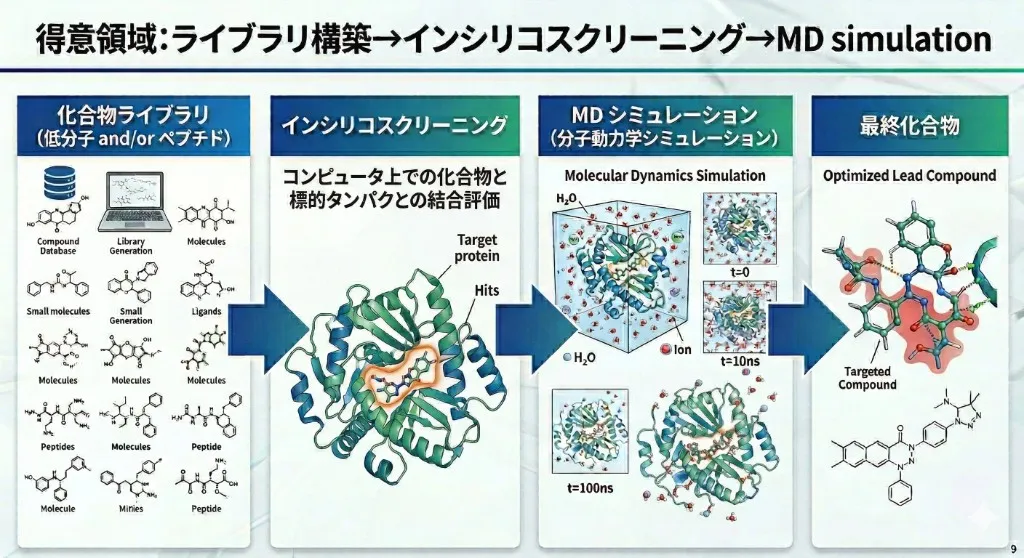
Design and filter a library of small molecules and/or peptides from public databases to fit your target.
Evaluate binding to the target protein computationally by docking and narrow down hit compounds.
Verify complex stability with molecular dynamics and estimate binding energies with MM/PBSA and related methods.
Propose compounds after interaction analysis and ADMET evaluation, and write the paper.
No programming experience
Programming experience
AFTERWARDS
Before
After
COMPARISON
| BaraPhaSilico | Graduate school | Coding bootcamp | |
|---|---|---|---|
| Fees | From JPY 20,000 per month (academia / individuals). Companies: JPY 300,000 lump sum. | Hundreds of thousands to over JPY 1,000,000 per year. | Hundreds of thousands of yen. |
| Duration | From a few months; designed around your topic through to publication. | Two years for a master’s, three or more for a PhD. | A few months; ends when the curriculum ends. |
| Publication | Mentoring through to publication on your own research topic. | Publication on the lab’s topic; progress depends on your supervisor. | Not covered. Research and publication are out of scope. |
| Instructor | Direct mentoring by the founder, who came from the wet lab, taught himself in silico drug discovery, and published. | Your supervisor; the field depends on the lab. | Software engineers; limited experience in drug discovery or research. |
Descriptions of graduate school and bootcamps are typical examples.
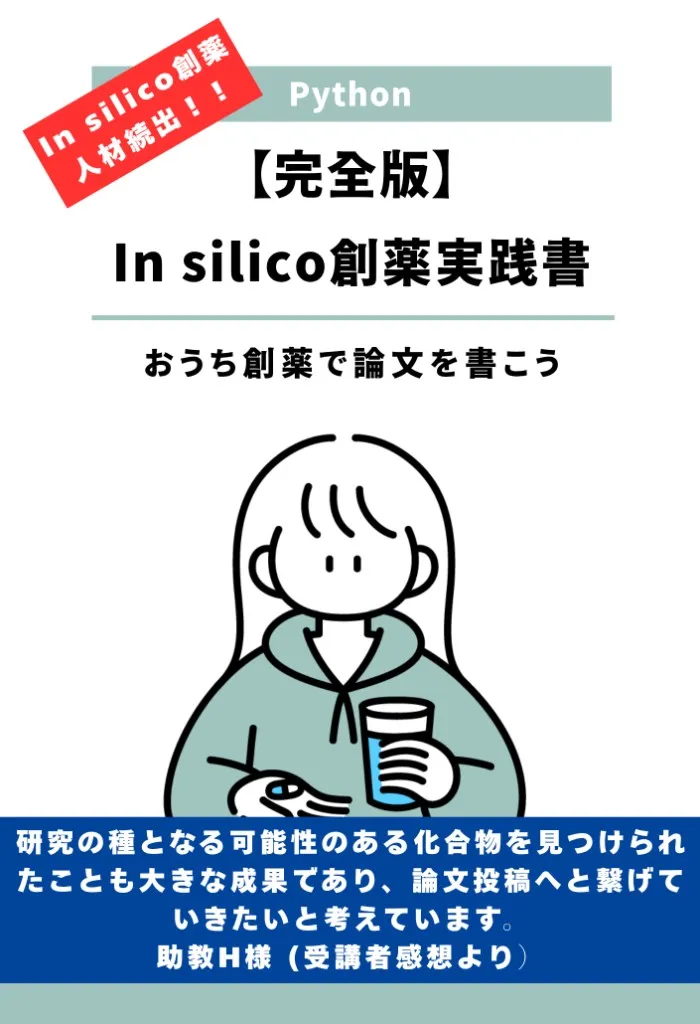
This is the textbook we teach from. It is updated regularly.
Read on Zenn (Japanese)Shinbara K. et al., Molecules 2025, 30(22), 4370.
I had no background in bioinformatics, yet the basics of in silico screening of a small-molecule library against a target protein were explained in a way I could follow. I did not even know how to use a command line, and I hit error after error, but I still made it from setting up a virtual environment all the way to running an MD simulation. I owe that to my mentor and I am truly grateful.
The technical book was also updated with the points I stumbled on and with tools that were not covered when it was first written, which makes reviewing much easier (I look forward to further additions).
My own PC is probably not powerful enough to run MD simulations at full tilt, but this program has clearly lowered the barrier I felt towards bioinformatics. It has sparked a desire to understand the field more deeply; I intend to keep learning and build more practical skills, and if the chance arises I would very much like to be mentored again.
Postdoctoral researcher, M
My research had been centred on wet-lab experiments, so I was not very familiar with dry analysis or programming and felt some anxiety, but by actually working hands-on I learned a great deal.
Errors were frequent as I got used to Python, but each time I received careful guidance and was able to move forward while properly understanding every step. Gaining knowledge and intuition through practice, something you cannot get just by reading a book, was extremely valuable.
Because of my PC’s specifications I could not run the MD simulation myself and the actual calculation was run on my behalf, but I came to understand the workflow and its significance. The in silico screening also turned up compounds that could become the seed of a research project, a major outcome that I hope to carry through to a journal submission. Thank you for this valuable opportunity.
Assistant professor, H
PROGRAM
We mentor you through the textbook, video lectures and weekly meetings, combining the following as needed.
01
Linux/WSL, conda, GPU: we get the error-prone setup out of the way first.
02
Learn the Python you need by running analyses on your own data.
03
How to read papers, organise prior work and formulate testable hypotheses.
04
Actually run docking, virtual screening and MD simulations.
05
Safely bring generative AI into research, coding and writing.
06
Rewatch the video lessons as often as you need. The textbook code is maintained so it keeps running.
07
Journal selection, figure planning and reviewer response, planned from the start.
08
We review your code and help it grow into a reproducible analysis pipeline.
09
Ask anytime on Discord, discuss regularly on Zoom. Less time stuck alone.
PRICING
MonthlyJPY 20,000
Lump sumJPY 120,000
(tax included)
Lump sumJPY 300,000
(tax included)
FOR WHOM
FAQ
The mentoring program is built on the premise that you do the hands-on work. We explain concepts, review your code, help you get unstuck and discuss study design, but we do not run the analysis for you. In return, every skill and result you gain is yours. If you want methods beyond the program tools, see technology adoption and consulting. If you want to add computation to research you already run, see collaborative research.
Yes. Even if you have never used a command line, we start from environment setup and move one step at a time. Most past participants came from a wet-lab background.
Docking and data analysis run on an ordinary laptop (Mac, or Windows with WSL). MD simulation is more comfortable with a GPU; if that is not available to you, we discuss options at the first consultation.
The program is for people who can commit at least 10 hours per week. Duration and pace are designed together at the first consultation, based on your topic and goal (conference presentation, journal submission, etc.).
Academia and individuals pay JPY 20,000 per month (or JPY 120,000 lump sum). Companies pay JPY 300,000 lump sum. The company plan includes one month of technical advising after the program. All fees are tax included.
Yes. Our founder has provided technical consulting to overseas researchers and can prepare materials and hold discussions in English.
CONTACT
Enquiries about the mentoring program and a free first consultation are welcome. We usually reply within 2–3 business days.
SERVICES
If you want methods beyond the mentoring program tools, see technology adoption and consulting. If you want to add computation to research you already run, see collaborative research.